How to Climb the Grand Teton: A Complete Guide


The Grand Teton is the second-highest peak in Wyoming, the crown jewel of Grand Teton National Park, and on nearly every serious climber's bucket list. Rising nearly 7,000 feet above the valley floor without the visual softening of meandering foothills, it's also one of the most striking summits in the Lower 48 — visible from downtown Jackson, the ski resort, and even from the window seat of your inbound flight.
This guide covers what it actually takes to climb the Grand Teton with a guide service: the routes we use, what fitness you'll need, how long it takes, and what your days will look like from gear check to summit. If you've been thinking about climbing the Grand, here's everything you need to know to decide whether you're ready.
No prior climbing experience required. The Mountain Guides has guided thousands of first-time climbers to the summit of the Grand Teton since 1968. Our 3- and 4-day programs include a complete training day before you ever set foot on the mountain.
Grand Teton at a Glance
The Grand Teton stands 13,775 feet (4,199 meters) tall — here’s every number that matters before you climb it.
Elevation: 13,775 ft (4,199 m)
Rank: Highest peak in the Teton Range; second-highest in Wyoming after Gannett Peak (13,804 ft)
Rise above Jackson Hole: about 7,000 vertical feet from the valley floor
Location: Grand Teton National Park, Wyoming
First ascent: 1898, by the William Owen party (an 1872 claim by Langford and Stevenson is disputed)
Standard routes: Owen-Spalding (5.4) and the Upper Exum Ridge (5.5)
Typical guided climb: 2–4 days via our Corbet High Camp
Climbing season: mid-June through September
Experience required: none on a guided ascent — fitness matters more than your climbing résumé
How tall is the Grand Teton?
The Grand Teton rises to 13,775 feet (4,199 meters). It's the tallest peak in the Teton Range and the second-highest peak in Wyoming after Gannett Peak (13,804 feet), which stands in the Wind River Range, where we also guide.
From the summit you'll see the entire Jackson Hole valley, the Gros Ventre Mountains to the east, Teton Valley and the Big Hole Mountains stretching into Idaho, and the dramatic ridgelines of Grand Teton National Park unfolding to the north. On a clear day, the view extends well over a hundred miles.
Why climb the Grand Teton?
Few mountains carry the cultural weight of the Grand Teton. It was a navigational landmark for Native Americans and early European explorers. The first ascent — historically credited to Spalding and Owen in 1898 — remains genuinely contested, with a strong case made for an earlier ascent by Stevenson and Langford in 1872.
What's not contested is the mountain's role in American climbing history. The Tetons were a crucible for the golden age of American alpinism. Climbers who honed their craft on these peaks went on to pioneer the big walls of Yosemite, the spires of Patagonia, and the highest faces of the Himalayas.
The Grand Teton is also unusually accessible for a 13,000-foot alpine objective. There are no foothills to negotiate — the climb is a direct ascent, and it can be done in anywhere from one to four days, with multiple routes that suit different skill levels.
Is climbing the Grand Teton hard?
Yes — but not in the way most people assume.
The technical climbing is well within reach for someone with no climbing experience, provided you're guided. Our 3- and 4-day programs include a full day of skills instruction designed to get complete beginners ready for the routes we use on the upper mountain.
The real challenge is endurance and altitude. You'll cover roughly 14 miles round-trip with about 7,000 feet of total elevation gain. The hike to Corbet High Camp alone gains 4,200 feet over 7 miles. Summit day adds another 2,700 feet of climbing on top of that, much of it above 12,000 feet where the air is meaningfully thinner.
Mountain weather adds a layer of unpredictability. Afternoon thunderstorms are common in summer, and exposure to changing conditions requires both the right gear and the mental composure to make conservative decisions in real time. Your guide handles the route-finding and risk management — your job is to arrive in shape and ready to move.
Can you free climb the Grand Teton?
Yes. Free climbing means climbing under your own power while protected by safety systems — a rope and protection — to catch you in the event of a fall. (It's distinct from free soloing, which is climbing without ropes, and which we don't guide.)
The Grand Teton offers free climbing routes ranging from 5.5 to 5.12, so there's terrain that will challenge nearly any climber. Our guided programs use moderate routes well-suited to the format. If you're an experienced climber looking to push your grade on the Grand, ask about a private guided trip on more technical terrain.
What climbing grade is the Grand Teton?
We typically guide one of two routes:
The Pownall-Gilkey Route is direct, efficient, and one of the most straightforward lines to the summit. It's our default choice when the weather forecast is uncertain — we can see weather approaching from the west, and retreat is faster than from other routes on the mountain.
The Upper Exum Ridge (5.5) is the more famous of the two and one of the most prominent south-facing ridgelines in the Tetons. It takes you through classic features with names that have entered the climbing lexicon: the Step Across, the Golden Staircase, the Wind Tunnel, and the Friction Pitch. It's a longer day than the Pownall-Gilkey but gets morning sun early, making it a great choice when the forecast is solid.
Beyond these two, the Grand offers harder routes up to 5.12 for climbers seeking real technical challenge — the North Face is one of the 50 Classic Climbs of North America. Your guide will pick a route based on weather, time, your ability, and the rest of your party.
How long does climbing the Grand Teton take?
While it's possible to climb the Grand Teton in a single day — and skilled, fit alpinists do — a guided ascent for someone without significant climbing experience takes 4 days.
We offer two main itineraries:
3-Day Climb Plus Prep — Day one is a full day of skills training in Jackson Hole. Days two through four are on the mountain: hike to Corbet High Camp, summit day, descent.
4-Day Climb — All four days are spent on the mountain. Day one is the hike up Garnet Canyon to Corbet High Camp. Day two is skills training at altitude on the same rock you'll climb the next day. Day three is summit day. Day four is a flexible buffer — a second summit attempt if weather turned you back, more climbing if you summited, or a relaxed descent.
The 4-day option is our recommendation for most climbers. The training happens at 11,000 feet on the type and aspect of rock you'll actually be climbing. There are two opportunities to summit if weather doesn't cooperate. And the pace is genuinely more enjoyable than the rushed itinerary of a 3-day program.
What is climbing the Grand Teton like?
Day one starts the day before the trip with a gear check at the Black Diamond store in downtown Jackson. We go through everything you're planning to carry up the mountain to make sure nothing's missing and everything fits.
The next morning, you meet your guide at the Lupine Meadows trailhead. From there it's a 7-mile hike up Garnet Canyon — strenuous but spectacular, gaining 4,200 feet of elevation over 5–7 hours at a sustainable pace your guide will set. Most of it is on trail; some is on uneven terrain through the upper basin. You'll arrive at Corbet High Camp in the early afternoon.
Corbet High Camp is our basecamp at 11,000 feet, named for our founder Barry Corbet. It features a Weatherport quonset hut for cooking and gathering, individual Black Diamond tents with sleeping pads, and a clean water source. Your guide cooks dinner. You'll fall asleep under the shadow of the Grand.
Day two is skills training. After breakfast, your guide will get you outfitted with a helmet, harness, and belay device. You'll walk 10 minutes from camp to a world-class training area where you'll cover knots, climbing commands, movement on rock, multi-pitch technique, and rappelling. By the end of the day, you'll have everything you need for the summit.
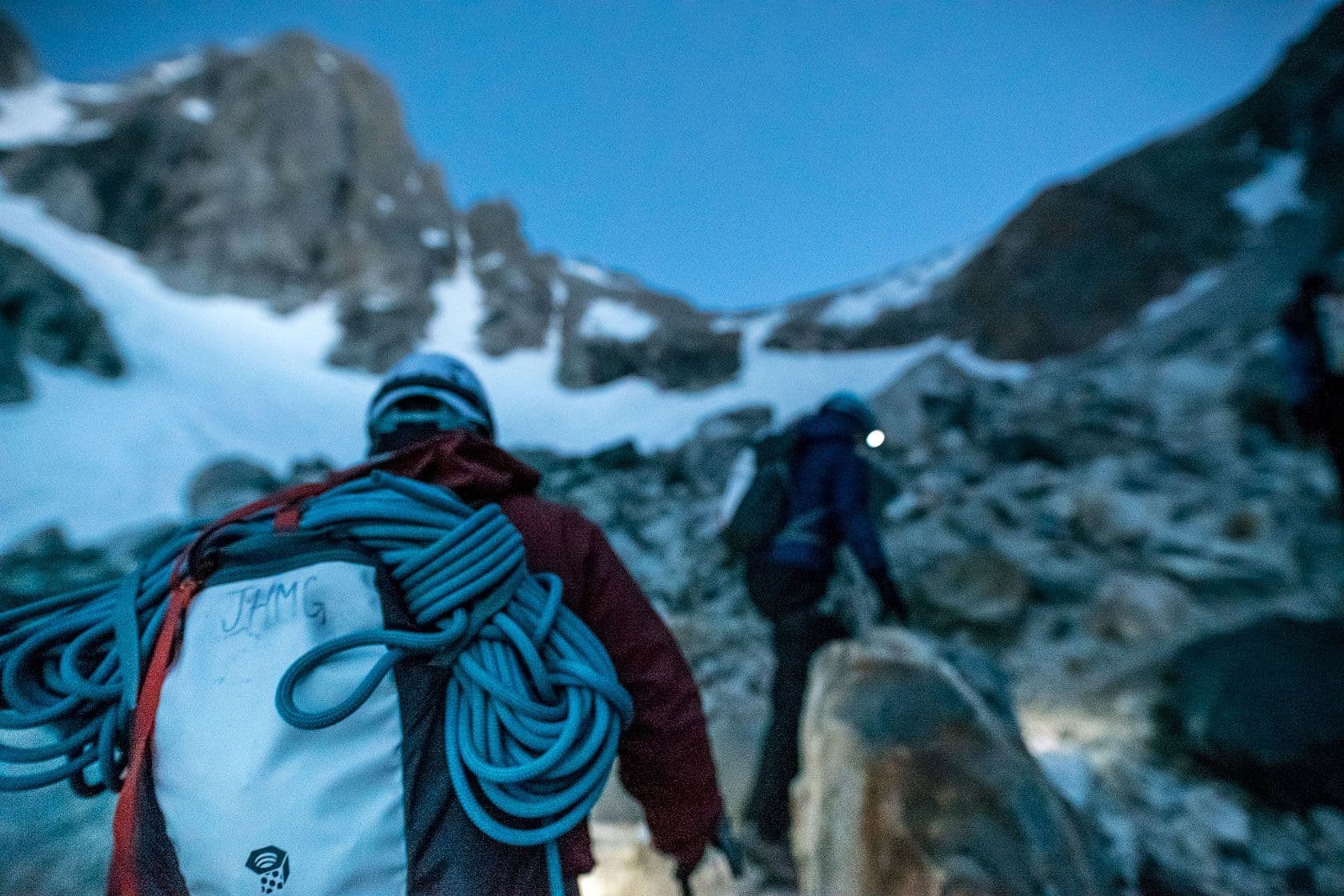
Day three is summit day. Very early wake-up, breakfast, and out the door with your summit pack — layers, headlamp, water, food, harness, helmet. The climb gains 2,700 feet over roughly 2 miles and takes 5–7 hours to the top. Slow, steady upward momentum is the key. Weather permitting, you'll stand on the summit, take in the view, and start the descent back to camp for a hard-earned dinner.
Day four depends on what happened on day three. If weather turned you back, this is your second chance. If you summited, you can climb another classic route nearby, relax at camp, or head down. We aim to leave camp by 10:00 AM and arrive back at Lupine Meadows between 2:30 and 3:30 PM.
How fit do I need to be?
Honest answer: fit enough that the hike doesn't break you before the climbing even starts.
We recommend at least two months of specific training before your trip. The most useful workout is carrying a 20–30 pound pack uphill — on trails, stadium steps, or a treadmill on incline. This simulates the actual demand better than anything else. Add three days a week of cardio (running, cycling, swimming, rowing) and weight training that focuses on quads, hamstrings, and core. On weekends, do longer hikes or sustained efforts to build stamina. Altitude is the other half of the equation — see our short guide to training for altitude with CO2-tolerance breath holds.
If you're not currently active or you're returning to fitness after a layoff, talk to your doctor before starting a new training program. We've guided plenty of climbers in their 60s and 70s to the summit — fitness matters more than age.
For more on what to expect logistically, our FAQ page has answers to the questions we hear most often, including age requirements, group vs. private trips, and what's included in your trip cost. We also explain why trip insurance is worth it for a Grand Teton climb.
Why climb the Grand Teton with The Mountain Guides?
The Mountain Guides — formerly Jackson Hole Mountain Guides — is the second-oldest guide service in the United States, founded in 1968 by Barry Corbet. We're AMGA-accredited at the organizational level and an authorized concessioner of Grand Teton National Park.
What that means in practice: every guide on our roster is a W-2 employee with at least Wilderness First Responder medical training. Many hold higher certifications. Our operations are reviewed annually by the National Park Service, which scrutinizes our hiring practices, risk management procedures, insurance, and customer satisfaction. We welcome that scrutiny — it makes us better.
The 4-day Grand Teton program at Corbet High Camp is what we're best known for. It's the experience that built our reputation, and it's still the program we run more than any other.
Ready to climb?
The Grand Teton books fast. Most summer dates fill 6–12 months in advance, with peak July and August dates often booked a year out. If you're considering it, reach out sooner rather than later — we can help you pick the right itinerary, talk through fitness preparation, and answer any questions before you commit.
Book your Grand Teton climb — or contact our office at (307) 733-4979 to discuss your trip.


