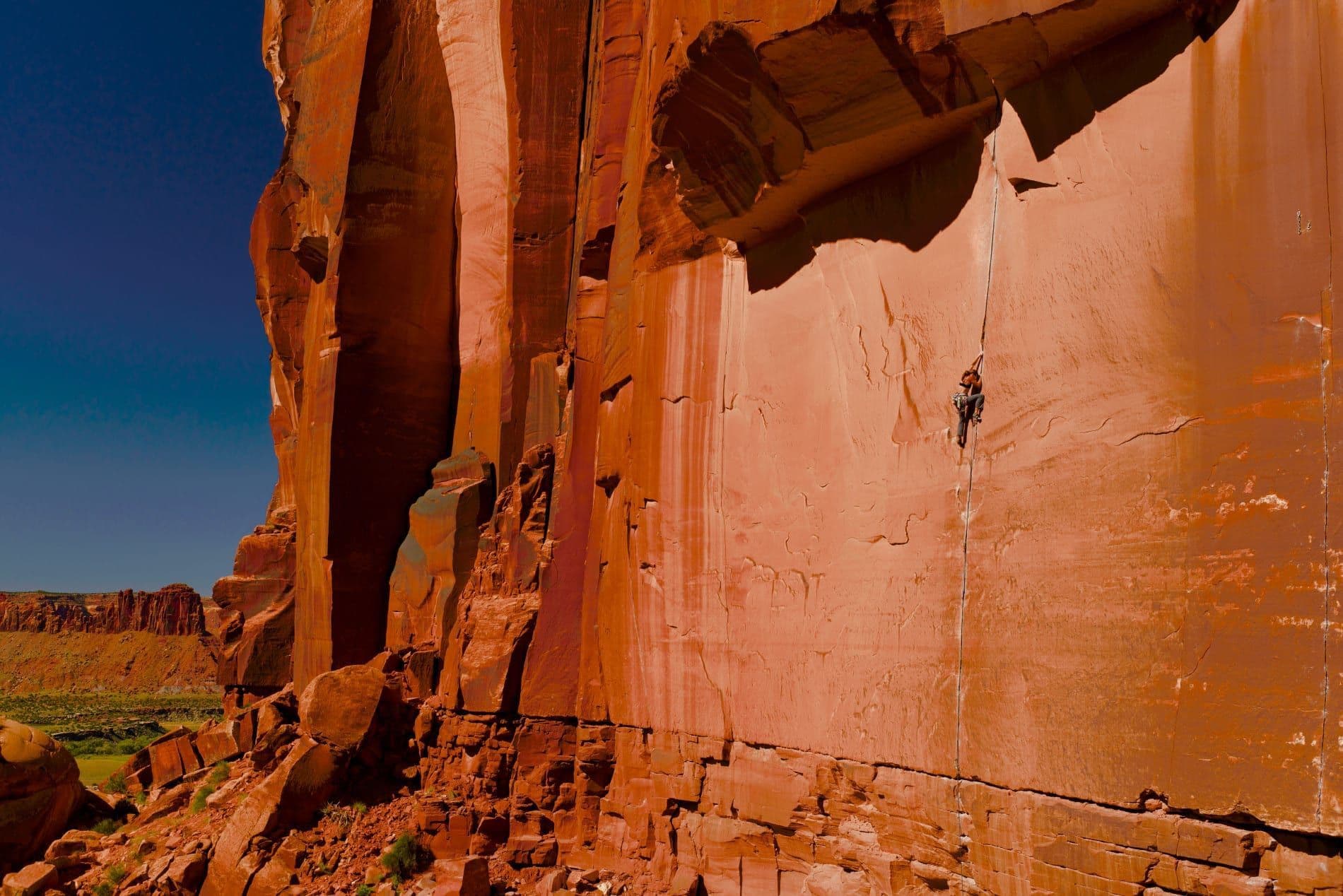
Indian Creek Climbing: The Complete Guide to Crack Climbing in the Creek


Indian Creek is the best splitter crack climbing on Earth, and it is about an hour from Moab. Hundreds of parallel-sided Wingate sandstone cracks run for a full pitch without changing size, so every route is a lesson in one jam — fingers, hands, fists or wider. This guide covers what climbing at the Creek is really like, how hard it is, the technique and gear it demands, when to go, where to camp, and how we run guided days there.
Indian Creek Climbing at a Glance
Location: Indian Creek Special Recreation Management Area, Bears Ears National Monument, roughly 50 miles south of Moab, Utah.
Rock: Wingate sandstone. Vertical, parallel-sided cracks in 100–150 ft pitches; very little face climbing.
Style: Almost entirely traditional single-pitch crack climbing, plus a few classic towers (North and South Six Shooter).
Grades: 5.9 to 5.13+, but the sweet spot for most visitors is 5.10 hand cracks. Grades feel stiff if you are new to crack.
Best seasons: Mid-March through May and October through mid-November.
Guided trips: Indian Creek crack climbs with The Mountain Guides — the only AMGA-accredited guide service based in Moab.
What Makes Indian Creek Crack Climbing Different
Crack climbing is a form of rock climbing that follows fissures in the rock rather than holds on its surface. Instead of pulling on edges, you jam hands, fingers, and feet into the crack and progress upward on the friction of the jam. It demands precise technique, endurance, and mental fortitude, making it both physically and mentally engaging — and because it is one of the most technique-intensive forms of climbing, learning from a guide or mentor is highly recommended.
What sets the Creek apart is consistency. Most crack climbs around the world change size every few feet; at Indian Creek a crack can stay exactly the same width for 100 feet. That means a route is perfect hands for the whole pitch, or perfect fingers, or a relentless off-width. It is why climbers describe routes here by size rather than by moves, and why a rack of eight identical cams is a normal thing to carry. The remote, pristine setting adds solitude and serenity, and the sheer concentration of high-quality cracks builds the most durable technique you can have in your climbing arsenal.
How Hard Is Indian Creek?
Harder than the number suggests, for most people. There are very few routes under 5.10 because a hand crack in solid Wingate is, by definition, about 5.10 — and a 5.10 hand crack at the Creek can shut down a gym climber who leads 5.12 on plastic. The good news is that the grade tracks crack size more than fitness: once your hand jam clicks, whole walls open up. Our advice for a first trip is to expect the grades to feel stiff, start on the most secure hand cracks, and let your guide pick sizes that fit your hands.
Classic Climbs at Indian Creek
Indian Creek boasts an impressive array of classic climbs, each with its own distinct character. Supercrack of the Desert (5.10) at the Supercrack Buttress is the rite of passage — a splitter hand crack that put the Creek on the map. Next door, Incredible Hand Crack (5.10) is exactly what its name promises. Scarface (5.11) is a longer, more sustained test on the Scarface wall, and The Cave Route (5.10) is a small splitter hand crack in an unlikely setting. For a summit, Lightning Bolt Cracks (5.11) on the North Six Shooter is an iconic tower climb that will challenge any veteran crack climber.

Crack Climbing Technique: The Basics We Teach
Every guided day at the Creek starts on the ground with jams. These are the techniques you will use, from smallest to widest:
Finger locks. For thin cracks, slot your fingers in and rotate so the knuckles cam against the sides. Thumb-down locks are the most secure.
Ring locks. For cracks just too wide for fingers, stack your thumb under your index finger to fill the space. Awkward at first, then indispensable.
Hand jams. The Creek's signature move. Slide your hand in, tuck the thumb into the palm to expand the hand, and let the crack hold you. When it is the right size it feels like a jug.
Fist jams. When the crack is wider than a hand, turn the hand into a fist so the knuckles and the heel of the hand press the walls.
Off-width. Wider than a fist and narrower than a chimney: arm bars, chicken wings and heel-toe foot jams. Nobody loves it on day one.
Foot jams. The most under-taught skill. Turn the foot sideways, insert the toe, and rotate it flat to lock. Good feet turn a pumpy crack into a rest.
Two things make all of this easier: tape gloves or crack gloves to protect the backs of your hands, and a pair of stiff, flat, low-profile rock shoes rather than aggressive downturned ones. We tape everyone up before the first climb.
When to Go: Indian Creek Weather and Seasons
The Creek sits at about 5,000 feet in the high desert, so the climbing seasons are spring (mid-March through May) and fall (October through mid-November). Spring is the busiest; fall has the best rock temperatures and quieter weekdays. Summer afternoons regularly exceed 100°F and the walls bake, though early-morning climbing on shaded walls is possible. Winter is cold, short and windy, with occasional workable days on south-facing buttresses. Wall aspect matters year-round: many crags get sun in the morning and shade in the afternoon or vice versa, and your guide will pick the wall that matches the forecast.
As with all Moab-area sandstone, do not climb the Creek when the rock is wet. Wingate loses much of its strength after rain, and cams placed in wet cracks can blow through the rock. Give it a day or two of sun after any storm.
How to Get to Indian Creek
From Moab, drive south on US-191 toward Monticello for about 40 miles, then turn right onto UT-211 toward Canyonlands' Needles District. The road descends a winding hill past Newspaper Rock and arrives in the Creek corridor; the main climbing walls line both sides of the road for the next 15 miles. Plan on about an hour from Moab. The closest airports are Canyonlands Field in Moab (limited flights), Grand Junction, Salt Lake City and Denver — a rental car is required, and there is no cell service in most of the Creek.
Camping at Indian Creek
The Creek is a camp-and-climb destination. The BLM runs established campgrounds at Creek Pasture, Superbowl and Hamburger Rock, all first-come, first-served with vault toilets and no water, plus designated dispersed sites along Beef Basin Road. Bring all of your water, pack out everything including human waste where required, and check the current Bears Ears rules for group sizes and fires before you go. Moab is close enough that day-tripping is realistic if you would rather sleep in a bed.
What a Guided Day at Indian Creek Looks Like
Indian Creek is more than a climbing destination; it is a sanctuary for people who embrace the raw beauty of the natural world, and it is one of the best places anywhere to learn to crack climb with a guide. We meet in Moab or at the Creek, tape up, and start with ground-school jams and a warm-up on secure hand cracks. From there we work through sizes and grades that fit your hands and your goals — a progression of splitters at Supercrack Buttress or a quieter wall, or a tower like the Six Shooter for experienced climbers.
Hiring a guide also solves the biggest logistical problem of the Creek: gear. Many routes require eight or more of the same size cam, which almost no individual climber owns, and we bring the full rack. We will help you choose climbs suited to your experience so you do not get in over your head, and as the only AMGA-accredited guiding service based in Moab we will get you on the rock faster with fewer hassles. Stay for the day, or camp under the stars and climb again tomorrow. See the Indian Creek crack climbing trip for dates and details, or read our Red Rock vs. Moab comparison if you are still choosing a desert destination.
Indian Creek Climbing FAQ
Is Indian Creek good for beginners?
Not for a first-ever climbing day — there is almost nothing under 5.10 and it is all trad. It is an excellent place for a first crack climbing trip if you already climb, especially with a guide who can set top ropes on the right sizes. New climbers do better starting at Wall Street in Moab.
How much gear do you need for Indian Creek?
More of the same size than anywhere else. A single classic hand crack can take six to ten cams of one size. Guided trips include the full rack; if you climb on your own, plan to combine racks with partners.
Do you need a permit to climb at Indian Creek?
No permit is required for day climbing. Camping is limited to designated sites, group sizes are capped, and guided groups operate under a commercial permit that we hold.
How far is Indian Creek from Moab?
About 50 miles and roughly an hour of driving via US-191 and UT-211.
Can I climb Indian Creek as a day trip from Moab?
Yes. Most of our guided Creek days are run from Moab with an early start; multi-day camping trips are available for climbers who want more time on the rock.
